What If the Problem Isn't the Principle—but the Paradigm?
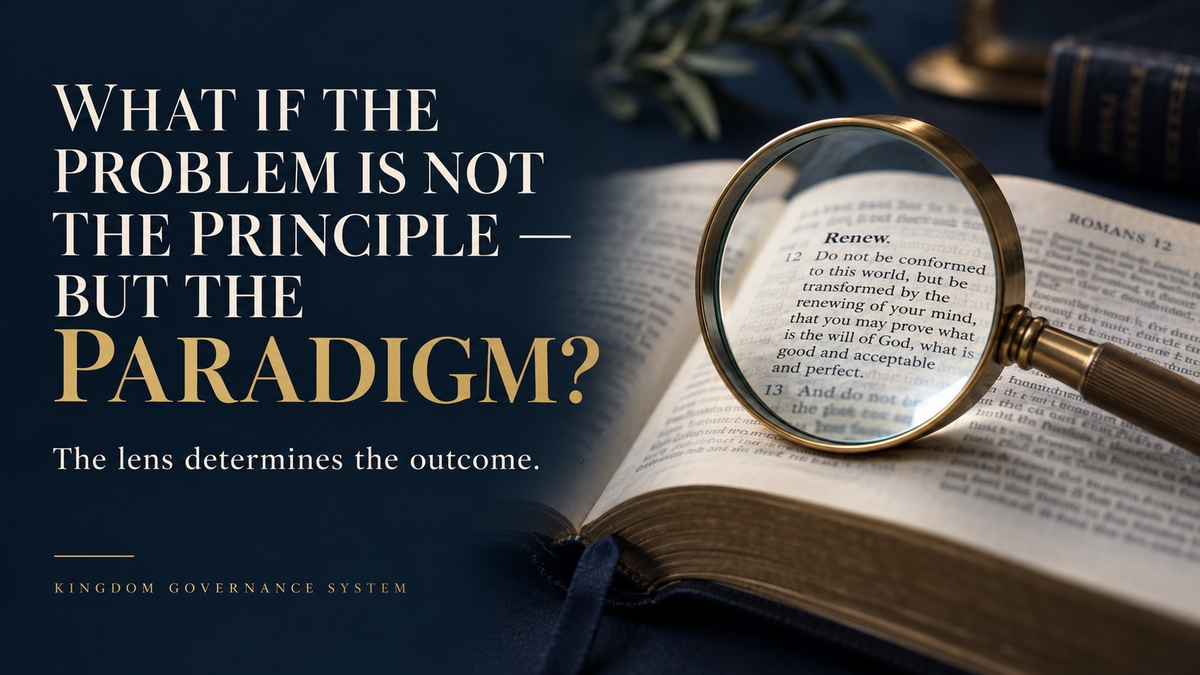
WHAT IF THE PROBLEM IS NOT THE PRINCIPLE — BUT THE PARADIGM?
You can know the Scriptures and still approach them through a lens that keeps you from experiencing their intended results. That is one of the most important insights documented in The Kingdom Governance System, and it may explain why so many sincere people remain stuck despite genuine effort and real devotion.
THE LENS DETERMINES THE OUTCOME:
Every human being operates from a paradigm. The Kingdom Governance System describes a paradigm as the ideas, assumptions, and values that shape a worldview — the lens through which we interpret life, make decisions, and respond to what is happening around us. The critical question is not simply whether someone engages with the Scriptures. The question is which paradigm they bring to that engagement.
The system identifies a sobering pattern. Many people enter into a relationship with God and then, almost without realizing it, pick up another paradigm to live their life by. They may adopt a religious paradigm — one built around disciplines and forms that carry the appearance of structure but lack the substance of divine intention. They may filter their understanding through cultural assumptions, institutional habits, or a worldview shaped more by the surrounding world than by Kingdom realities. When that happens, even accurate knowledge of scriptural principles can produce limited results, because the operating system beneath the knowledge is misaligned.
THE GAP BETWEEN KNOWING AND EXPERIENCING:
The Kingdom Governance System draws attention to a gap that is impossible to ignore. People who follow Christ are meant to be living demonstrations of real answers — healing, provision, strength, and strategies that overcome challenges. Yet too often, observers see similar struggles and comparable outcomes on both sides of belief. The system is direct about this: our experience needs to change.
This gap is not primarily a knowledge problem. The Scriptures are clear. The principles are accessible. What is missing in many cases is a paradigm shift — a fundamental change in the way a person thinks and processes reality. The system points to the instruction to renew the mind not as a suggestion but as a governing requirement. When a person is born again, the spirit is regenerated, but the mind is not automatically transformed. The mind must be intentionally reprogrammed, aligned to think the way the Kingdom operates rather than the way the world does. The gatekeeper of experience is the mind, and until the paradigm governing the mind is replaced, the principles a person knows will struggle to produce their intended fruit.
THE ONLY PARADIGM THAT FITS:
The Kingdom Governance System is unambiguous on this point. Jesus did not come to reform existing paradigms — political, religious, cultural, or personal. He came to replace them entirely with the Kingdom of God, described in the system as the original and perfect plan for humanity. Humanity was made for the Kingdom, and the Kingdom was made for humanity. No other system fits the human design.
CLOSING THOUGHT:
The invitation documented in The Kingdom Governance System is not to know more about a system — it is to live from within one. When the paradigm shifts, the principles already known begin to produce what they were always designed to deliver. The problem was never the principle. It was the lens.